Martial law in Gotham City
Batman the Dark Knight Returns 10th Anniversary Edition HardcoverMartial law in Gotham City is the emergency condition that emerges when the city’s ordinary institutions can no longer contain violence or guarantee public order. It is not merely a legal proclamation but a shifting mode of rule: authority passes among the Gotham City Police Department, criminal groups, armed civilians, and Bruce Wayne / Batman as crisis repeatedly suspends the normal boundaries of law, policing, and private force.
Definition and Background
Martial law becomes intelligible against Gotham City’s long social decay. The city has already lost confidence in its institutions before the later emergency, while recurring violence and the return of Bruce Wayne / Batman reveal how fragile the official order has become. The authorities’ reliance on exceptional measures follows a broader pattern in which ordinary law is treated as inadequate to extraordinary danger. The emergency therefore does not arrive as an isolated interruption; it is the formal expression of a breakdown that has been developing throughout the narrative.
The city’s crisis is intensified by the Mutant Gang, whose power challenges the state’s monopoly on force. Their rule makes public space subject to intimidation rather than dependable civic protection, and the conflict with Bruce Wayne / Batman demonstrates that the government cannot simply restore order through routine policing. When the city is later plunged into a blackout, the disappearance of electrical infrastructure further strips away the practical supports of administration, communication, and surveillance. Martial law becomes the language of a government attempting to govern a city in which its ordinary mechanisms have already failed.
Suspension of Ordinary Authority
The emergency changes the relationship between legality and force. The Gotham City Police Department remains an official institution, but its authority is repeatedly tested by armed criminals, mass unrest, and the uncertain presence of Bruce Wayne / Batman. The crisis gives coercive power an urgent justification: actions that would be unacceptable under settled conditions can be presented as necessary responses to public danger. Yet the narrative keeps the source of legitimacy unsettled, because the same emergency that empowers the state also creates room for unauthorized actors to claim that only direct action can save Gotham City.
This instability is visible in the contrast between official command and personal authority. Governmental power depends on decrees, police structures, and the expectation of obedience to institutions. Bruce Wayne / Batman commands through reputation, tactical competence, and the ability to act when formal authorities hesitate. The Mutant Gang and, later, the Sons of Batman rely on still different foundations: organized street force and allegiance to a model of heroic discipline. Martial law thus becomes a contest over who may define the emergency and who may decide which forms of violence count as protection rather than rebellion.
Crisis, Blackout, and Social Control
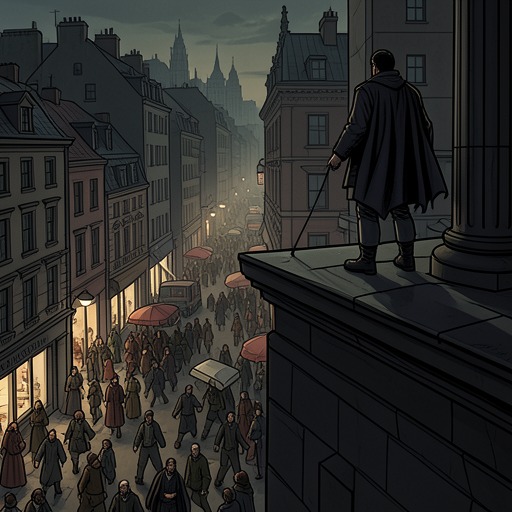
The Gotham City blackout turns emergency government into a material experience for the population. With the city’s systems disrupted, the distinction between public order and private survival becomes dangerously thin. Citizens face conditions in which conventional protection cannot be assumed, and the absence of dependable infrastructure allows fear, opportunism, and collective violence to spread. The blackout does not simply accompany martial law; it helps produce the circumstances in which exceptional authority appears indispensable.
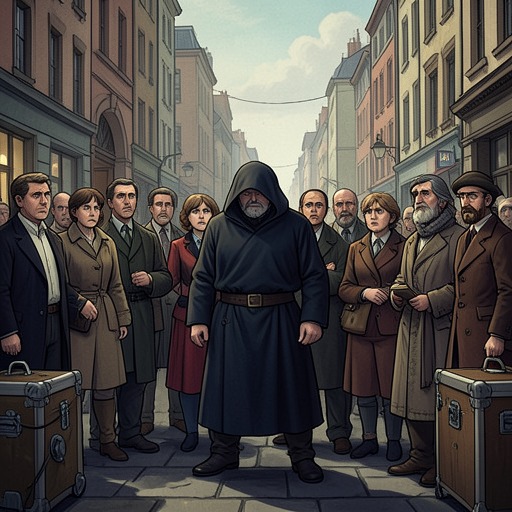
The emergency also alters how Gotham City’s residents participate in politics. They are not only subjects to be controlled by police measures. Their fear, anger, and willingness to follow strong leadership become part of the struggle over the city’s future. Bruce Wayne / Batman’s interventions draw civilians into the restoration of order, while the Sons of Batman transform the symbolism of his return into a broader movement. The result is a city in which authority is increasingly performed in public: whoever can gather people, direct them, and make the streets appear governable can begin to function as a political power.
The Sons of Batman and the Transfer of Power
The rise of the Sons of Batman reveals the most consequential transformation within the emergency. They emerge from the violence surrounding Bruce Wayne / Batman’s campaign against Gotham City’s disorder and eventually take over functions that the official government and police cannot reliably perform. Their assumption of control is not presented as a normal constitutional succession. It is a de facto transfer of power produced by collapse, loyalty, and the practical need to fill an institutional vacuum.
Their rule carries an important contradiction. The Sons of Batman oppose the criminal domination associated with the Mutant Gang, yet their authority also originates in force and in the exceptional example set by Bruce Wayne / Batman. They inherit the idea that order may have to be imposed before it can be legitimized. In that sense, the emergency does not simply end when one violent power defeats another; it changes hands. The city moves from gang rule, through official emergency measures, toward a new order whose moral authority comes from Batman’s example but whose practical instruments remain coercive.
Consequences and Narrative Significance
Martial law in Gotham City makes the city’s political problem impossible to separate from its superhero problem. The central question is not only whether violence can be stopped, but who is entitled to stop it when the law is suspended or powerless. The Gotham City Police Department, the government, Bruce Wayne / Batman, and the Sons of Batman each represent a different answer, and none is entirely free from the danger of authoritarian force.
The condition also prepares the final conflict between Bruce Wayne / Batman and Clark Kent / Superman. As the domestic emergency expands into a confrontation over the acceptable limits of power, the logic of exceptional rule reaches beyond Gotham City’s streets. The same argument that justifies extraordinary action against gang violence can justify opposition to any authority that stands above ordinary accountability. Martial law therefore functions as a recurring political atmosphere rather than a single episode: it normalizes the suspension of rules, exposes civilians to direct coercion, and makes the restoration of order inseparable from the question of whether the new order will reproduce the violence it claims to overcome.
By the end of the crisis, Gotham City has not simply returned to its earlier condition. Its institutions have been exposed as vulnerable, its citizens have been drawn into collective action, and the Sons of Batman have become evidence that Bruce Wayne / Batman’s authority can outlive his visible presence. Martial law’s deepest consequence is this redefinition of sovereignty. In an emergency, the city is ruled by the actor capable of converting fear and disorder into obedience; the narrative leaves the legitimacy of that conversion deliberately unstable.